The Bird Streets · 90069
The Streets
A cluster of bird-named roads climbing above the Sunset Strip in the Hollywood Hills, the Bird Streets sit within the 90069 zip code, bordering Trousdale Estates to the west and Sunset Plaza below. Each street is named for a bird—and each has its own architecture, altitude, and mythology. Explore them below.

Blue Jay · Cyanocitta cristata
Blue Jay Way
The street that gave the enclave its mythic origin—where George Harrison waited out the fog and wrote a song.
Enter the Street →
Bullock's Oriole · Icterus bullockii
Oriole Drive
Cubist modernism and old Hollywood pedigree on one of the enclave’s most architectural streets.
Enter the Street →Hooded Oriole · Icterus cucullatus
Oriole Way
The western stem of the Oriole family, where a legendary producer held the promontory.
Enter the Street →
Western Tanager · Piranga ludoviciana
Tanager Way
A modern architectural street named for the most vividly colored songbird in the western hills.
Enter the Street →
Eurasian Nightingale · Luscinia megarhynchos
Nightingale Drive
The frontier of luxury, where mega-mansions with retractable roofs chase nine-figure ambition.
Enter the Street →
American Robin · Turdus migratorius
Robin Drive
The view-lot capital of the Bird Streets, where the city falls away to the ocean.
Enter the Street →
Barn Swallow · Hirundo rustica
Swallow Drive
The mid-century soul of the Bird Streets, where 1961 modernism still sets the tone.
Enter the Street →
California Thrasher · Toxostoma redivivum
Thrasher Avenue
The highest-priced perch in the enclave, where estates command close to nine figures.
Enter the Street →
Eurasian Skylark · Alauda arvensis
Skylark Lane
A lower, greener stretch where modern mansions sit behind walls of mature privacy.
Enter the Street →
Golden-crowned Kinglet · Regulus satrapa
Kinglet Drive
A quiet, leafy street whose tiny namesake is the smallest bird in the enclave.
Enter the Street →
Northern Flicker · Colaptes auratus
Flicker Place
Celebrity pedigree and the enclave’s most ambitious new build.
Enter the Street →
Hermit Thrush · Catharus guttatus
Thrush Way
A slender, quiet spur off the upper ridgeline, named for the bird with the most haunting song in the North American forest.
Enter the Street →
Wilson's Warbler · Cardellina pusilla
Warbler Way
A mid-slope street named for a tiny yellow migrant that passes through the chaparral each spring.
Enter the Street →Orange-crowned Warbler · Leiothlypis celata
Warbler Place
A small cul-de-sac variant on Warbler, named for the understated warbler that nests in the hills year-round.
Enter the Street →Northern Flicker · Colaptes auratus
Flicker Way
The companion to Flicker Place, where the enclave's celebrity pedigree meets its most ambitious new architecture.
Enter the Street →
Western Bluebird · Sialia mexicana
Bluebird Avenue
A lower, sun-warmed stretch named for the bird that means, everywhere in America, a kind of good fortune.
Enter the Street →
Bobolink · Dolichonyx oryzivorus
Bobolink Place
A short, tucked-away close named for one of the great long-distance migrants of the Americas.
Enter the Street →
Northern Mockingbird · Mimus polyglottos
Mockingbird Place
A short central close named for the great mimic—the state bird of five American states, though not of California.
Enter the Street →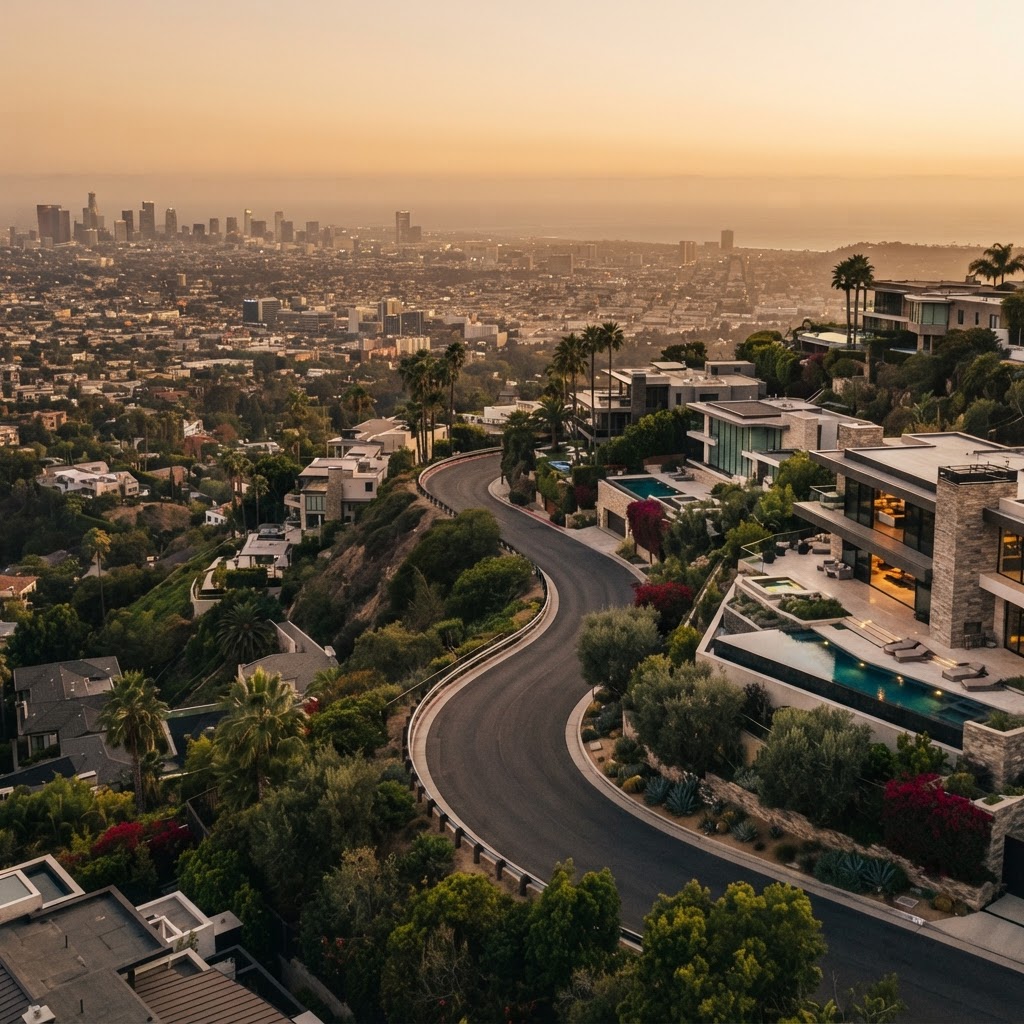
The Boundary
Doheny Drive
The grand western boundary of the Bird Streets—where the hillside luxury of 90069 meets the Sunset Strip below.
Enter the Street →
Budgerigar · Melopsittacus undulatus
Marcheeta Place
A cul-de-sac roosting just above the Bird Streets—named in 1924 alongside its feathery neighbors, and perhaps, the story goes, for someone's parakeet.
Enter the Street →
Warbling Vireo · Vireo gilvus
Vireo Drive
A leafy, mid-tier drive named for the plain gray songbird whose warble is the soundtrack of the western canopy.
Enter the Street →Frequently Asked
About the Bird Streets
The questions buyers and neighbours ask most often, answered from public records and this site’s own street research.
- What are the Bird Streets?
- The Bird Streets are a cluster of bird-named roads climbing the hillside directly above the Sunset Strip, inside the City of Los Angeles in the 90069 zip code. The names began appearing on Los Angeles maps in 1924 and kept being added for the next four decades; an early Renie atlas of the hills held in the Los Angeles Public Library’s Central Library collection shows nineteen of them. Twenty-one streets have pages on this site.
- Are the Bird Streets in Hollywood Hills, Beverly Hills or West Hollywood?
- All three labels get used, which is why the same house can appear under different neighbourhoods on different listing sites. Geographically the Bird Streets sit inside the City of Los Angeles, in the Hollywood Hills above the Sunset Strip, bordering Trousdale Estates to the west and Sunset Plaza below. Depending on the agent they are marketed as Hollywood Hills, Beverly Hills or West Hollywood.
- Which streets are in the Bird Streets?
- Blue Jay Way, Oriole Drive, Oriole Way, Tanager Way, Nightingale Drive, Robin Drive, Swallow Drive, Thrasher Avenue, Skylark Lane, Kinglet Drive, Flicker Place, Flicker Way, Thrush Way, Warbler Way, Warbler Place, Bluebird Avenue, Bobolink Place, Mockingbird Place, Vireo Drive, Marcheeta Place and Doheny Drive, which forms the enclave’s western boundary. Each has its own page on this site.
- Why is Blue Jay Way the best-known street?
- George Harrison rented a house at 1567 Blue Jay Way in August 1967 and wrote “Blue Jay Way” there while waiting for a friend lost in the hillside fog. The Beatles recorded it at EMI Studios in London that September, and it closed the “Magical Mystery Tour” double EP in Britain on 8 December 1967. Blue Jay Way is also one of the newest names in the enclave — it was added in the 1960s, decades after the original cohort.
- Why do Bird Streets homes command such a premium?
- Two things compound. The ridge lots look south across the whole Los Angeles basin from downtown to the Pacific, and that sightline cannot be manufactured anywhere else this close to the Strip. At the same time the City of Los Angeles Baseline Hillside Ordinance limits how much house a hillside lot can carry, so supply of large new homes on big views is capped by ordinance rather than by demand. Reported sales in the enclave include Dr. Dre’s house at $35 million.
- What are the rules for building or renovating in the Bird Streets?
- Construction falls under the City of Los Angeles Baseline Hillside Ordinance, which applies to residential building in the city’s designated Hillside Areas. Instead of a single size cap, permitted floor area is calculated by slope: a surveyor maps how much of the lot falls in each slope band, each band carries its own floor-area ratio, and the allowance is the sum — so a steeper lot yields a smaller house. Height is measured as an envelope that steps with the grade, and grading permitted by right is capped at a share of lot size plus a fixed allowance before discretionary review is needed.
- Who lives in the Bird Streets?
- The enclave has drawn a well-documented roster for decades. Residents reported over the years include Leonardo DiCaprio, Tobey Maguire, Jodie Foster, Keanu Reeves, Herbie Hancock, Stan Lee, Larry Flynt and Christina Aguilera, and Jennifer Aniston was reported to have rented in the area for around $20,000 a month. Privacy is part of what is being bought, so current ownership is rarely public.
- How were the streets named?
- Each is named for a bird, and the programme ran a long time: the first names appeared in 1924 and new ones were still being added into the 1960s. The pattern is not strictly local — Mockingbird Place is named for the Northern Mockingbird, the state bird of five American states but not of California. Two streets sit outside the pattern: Doheny Drive, named for the oil family whose estate below was later subdivided into Trousdale Estates, and Marcheeta Place, platted in 1924 alongside the bird names but never given one of its own.
More context in the history of the enclave, or browse homes for sale and homes for lease in the Bird Streets.