
Elevation
790 m
A cul-de-sac roosting just above the Bird Streets—named in 1924 alongside its feathery neighbors, and perhaps, the story goes, for someone's parakeet.
Named With the Flock
Marcheeta Place was platted in 1924, at the same time as its feathery neighbors, and it was originally called Marcheeta Drive. Nothing was built on the street until 1960, by which point it had been rechristened Marcheeta Place. The street sits just above the so-called Bird Streets—a cul-de-sac with a non-avian moniker that nevertheless roosts among the flock.
What's a Marcheeta?
"Marcheeta" was, in fact, a woman's name in the early twentieth century—not a common one, but not unheard of either. No Marcheeta appears in the family trees of the Bird Streets developers, which leaves the origin open to the neighborhood's favorite theory: maybe it was someone's parakeet. We have adopted that theory as the street's patron bird—the Budgerigar, the small green-and-yellow Australian parrot that has been kept as a companion in Los Angeles homes for as long as the hills have been built. A parakeet, after all, is a bird that lives indoors by choice—the fitting mascot for a street whose homes turn their glass inward to courtyards and pools.
The McClean Benchmark
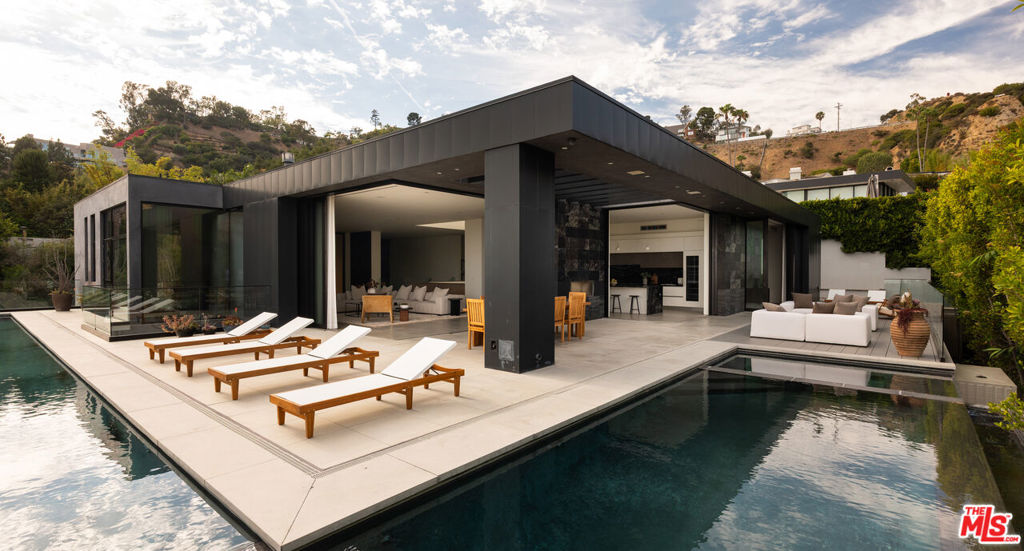
1822 Marcheeta Place—a brand-new architectural by Paul McClean, four bedrooms and seven bathrooms—sold for $18,350,000. The specification is the street's present chapter in miniature: twelve-foot ceilings, limestone floors, a custom wood-panelled ceiling, and a seventy-foot book-matched marble exterior wall put there for privacy. It set the tone for what Marcheeta is now: warm modernism engineered for the view lot, where the parcels tighten and the architecture turns inward toward courtyards and pools above Sunset Plaza.
The House That Shows What a Bird Streets Lot Is Actually For
Read the rest of 1822 and the logic of the whole enclave becomes legible. Below the main floor sit large entertaining spaces, a custom bar and an intimate cigar lounge; a custom gym with a full steam and sauna room; a suede-lined screening room seating eighteen; and a car museum built to display ten vehicles. It also has what its agents described as the first split-level swimming pool in the Bird Streets. Almost none of that programme needs a view, and that is the point: on a tight hillside parcel the view-facing frontage is the scarcest thing on the lot, so everything that does not require a sightline gets pushed down and back into the hill. A buyer comparing two Marcheeta houses on total square footage alone will miss this entirely. The question that decides value here is how many of those square feet actually face the view, and how many are excavated basement.
Thirty-Six Years of Nothing
The street was platted in 1924 as Marcheeta Drive, in the same wave that produced the bird names, and then nothing was built on it until 1960 — by which point it had been rechristened Marcheeta Place. That gap is not an oddity, it is the history of the whole enclave in one street. These roads were drawn on paper in the 1920s on the expectation of a hillside building boom that did not arrive on schedule; what filled them in was the post-war decades, and then the architectural rebuilding of the last twenty years. It is also why so little original 1920s fabric survives up here and why the architectural story of the Bird Streets is a mid-century and contemporary one rather than a Spanish Revival one.
A Cul-de-Sac, and Why That Is Worth Paying For
Marcheeta Place is a cul-de-sac, which on a hillside is a material amenity rather than a pleasant detail. A dead-end street carries only its own residents, so the noise floor is lower than on a through route like Doheny; there is no cut-through traffic looking for a shortcut to Sunset; and the number of parties whose future building plans can affect your sightline is bounded and knowable. The trade is access and parking: a cul-de-sac above Sunset Plaza means a single way in and out, tight turning, and construction logistics that are genuinely difficult and expensive — which matters a great deal if the plan is to build, as it usually is here.
What Can Be Built Here
New construction on Marcheeta falls under the City of Los Angeles Baseline Hillside Ordinance, which applies across the city's designated Hillside Areas. It sets no single size cap. A surveyor maps how much of the lot sits in each slope band, each band carries its own floor-area ratio, and the permitted floor area is the sum of those bands, so the steeper the parcel the less house it yields. Height is measured as an envelope that follows the grade, stepping with the hill, and grading permitted by right is capped at a share of lot size plus a fixed allowance before discretionary review is triggered. On a tight cul-de-sac parcel the grading cap is often the binding constraint rather than the floor-area one — which is exactly why the subterranean programme at 1822 is the interesting part of that house.
More in the Enclave
- Vireo DriveA leafy, mid-tier drive named for the plain gray songbird whose warble is the soundtrack of the western canopy.
- Doheny DriveThe grand western boundary of the Bird Streets—where the hillside luxury of 90069 meets the Sunset Strip below.
- Blue Jay WayThe street that gave the enclave its mythic origin—where George Harrison waited out the fog and wrote a song.
- Mockingbird PlaceA short central close named for the great mimic—the state bird of five American states, though not of California.
Read the history of the Bird Streets for how the enclave was named and built, browse all twenty-one streets, or see every Bird Streets home for sale and available for lease.
The Avian Feed
Residences on Marcheeta Place
Continue
Next · Vireo Drive